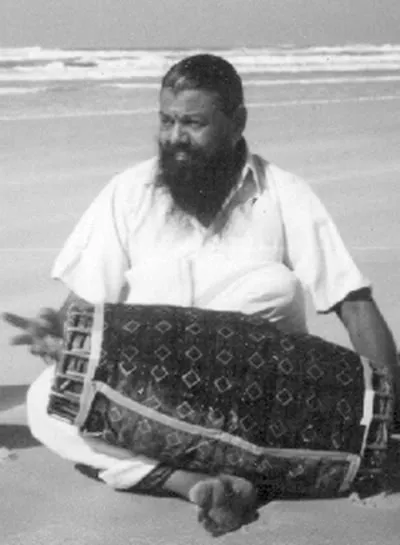
Vidwan Karaikudi R. Mani
Vidwan Karaikudi Ramasami Mani was one of the most revered mridangam maestros in the history of Carnatic music. Born in Karaikudi, Tamil Nadu, he studied mridangam under Karaikudi Ranga Iyengar and Harihara Sharma, but credited his spiritual guru Surajananda with transforming his approach to music entirely — guiding him through intense practice to develop the unique bani (style) that would become his hallmark. This fusion of rigorous technical training and deep spiritual grounding set him apart from the very beginning, and he went on to redefine the very identity of the mridangam as a concert instrument.
What set Karaikudi Mani apart was not merely his breathtaking virtuosity — the crystalline clarity of his strokes, the mathematical elegance of his korvais — but the profound humility and devotion with which he approached every performance. Whether playing at the grandest sabha or a village temple, he brought the same reverence. He treated the mridangam not as an instrument to be mastered, but as a divine voice to be served. His playing had a singing quality — the drum seemed to speak, to breathe, to pray.
In 1993, he presented the first-ever standalone Thani Avarthanam concert alongside kanjira maestro G. Harishankar — a landmark moment that proved South Indian percussion could stand alone as a complete art form. A recipient of the Padma Shri, the Sangita Kalanidhi (Music Academy, Chennai), and the Sangeet Natak Akademi Award, he accompanied legends including M.S. Subbulakshmi and D.K. Pattammal. Through his Sri Ramanathan Academy of Mridangam in Chennai, he trained generations of percussionists, ensuring his bani would endure far beyond his own lifetime.
A rare interview where Karaikudi Mani sir speaks about his musical journey, the philosophy behind his bani, and the spiritual dimension of the mridangam.
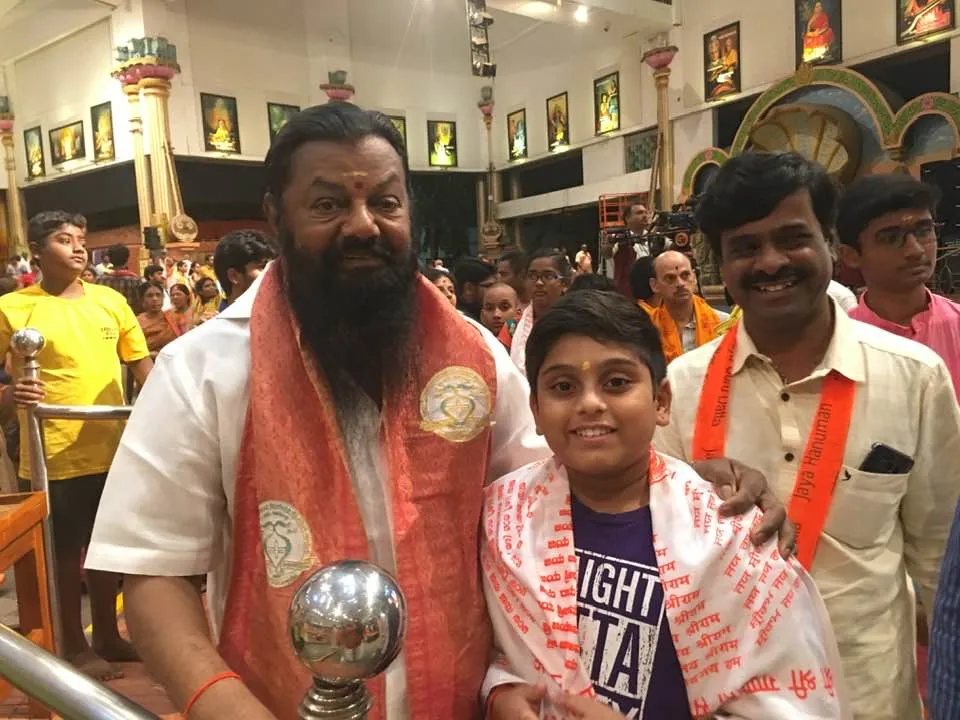

Vidwan Rudrapatna Shankar Ramesh
Vidwan Rudrapatna Shankar Ramesh is a distinguished mridangam artist and guru based in Mysuru, Karnataka. A dedicated disciple of Karaikudi R. Mani, he carries forward Karaikudi Mani sir's bani with its hallmarks of tonal beauty, mathematical precision, and musical sensitivity. Holding a Master of Science degree in Chemistry from the University of Mysore, Ramesh exemplifies the Indian tradition of the scholar-musician — equally at home in the world of science and art.
Vidwan Ramesh is a member of the Celestial Message troupe of Dattapeetham and has dedicated his skill to serve Sri Swamiji's music for healing mission. He is known for his refined layakari, sensitive accompaniment, and deep command of the mridangam's tonal palette and subtler aspects of accompanying devotional music and meditation music concerts. He has performed alongside many distinguished vocalists and instrumentalists, including flute maestro Vid. Mysore Chandan Kumar and other leading artists.
His connection to HH Dr. Sri Ganapathy Sachchidananda Swamiji and the SGS Raga Sagara ensemble has been a defining chapter of his musical life. Sri Swamiji himself foresaw that Ramesh would be his mridangam artist, and Ramesh has since performed at the sacred Nada Mantapa at Avadhoota Datta Peetham and at Raga Sagara meditation and healing concerts across the world. He has been the guru of Chidatma Datta Chaganti for thirteen years, transmitting not only the technical grammar of mridangam vaadhya but the deeper philosophy of laya as devotion.
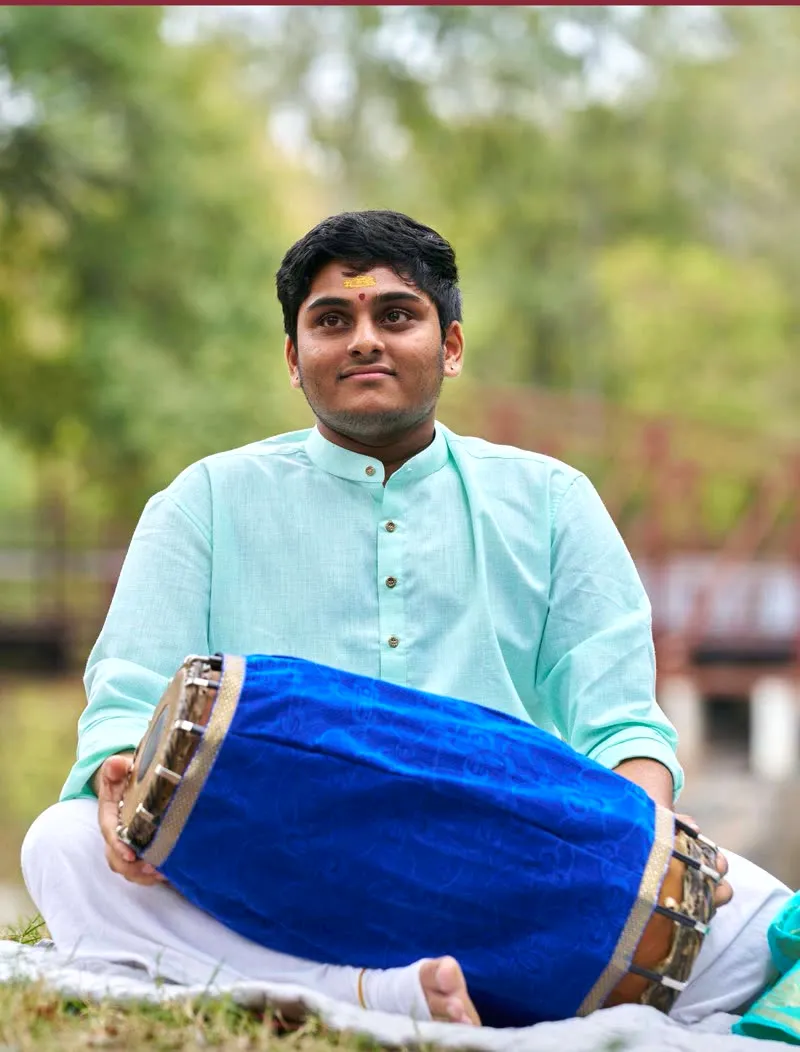
Chidatma Datta Chaganti
Chidatma Datta Chaganti has trained under Vidwan Rudrapatna Shankar Ramesh for thirteen years in Karaikudi Mani sir's bani, absorbing the nuances of laya, the grammar of mridangam vaadhya, and the art of sensitive accompaniment. A multiple-time 1st prize winner at the Cleveland Thyagaraja Aradhana — the most prestigious Carnatic music competition in North America — he has established himself as one of the most promising young percussionists in the diaspora.
His performance credits include the prestigious Nada Mantapa at Avadhoota Datta Peetham, Mysuru (accompanying Vid. Kunnakudi Balamurali Krishna), concerts featured on Padmashri A. Kanyakumari's channel, Shivaratri concerts at Shubham Fine Arts in Chennai, and the Margazhi 2025–2026 concert season in India. In March 2026, he tours the US as mridangam accompanist for the Cotah Sisters.
Rooted in the timeless guru-shishya parampara, Chidatma carries forward Karaikudi Mani sir's bani with devotion — bridging the worlds of tradition and technology as a Computer Science student at UT Dallas.